

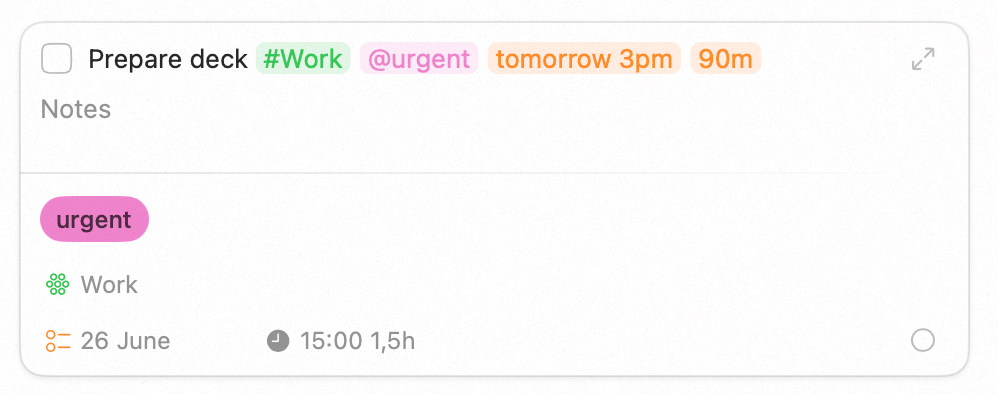
Typing a task with its details inline
Where it works
Natural language input is part of the task name field, wherever you can edit it:- When you add a new task.
- When you rename an existing one.
- In the Focus view.
- In the Edit in Panel floating editor on Mac.
Projects and areas — #
Type # to file a task in a project or area. A list of your projects and
areas appears as you type; keep typing to narrow it, then pick one. Multi-word names work, so
#Side Project matches just fine.
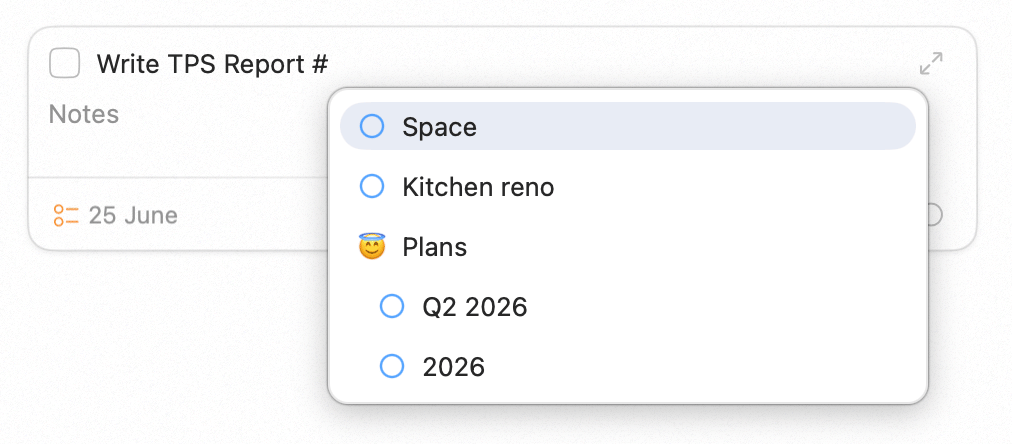
Choosing a project or area as you type
A task lives in one place, so if you type more than one
#, the last one wins. Only projects and areas
you’ve already created will match.
Tags — @
Type @ to add a tag. You can add as many as you like, and Sonto ignores
duplicates.
If you type a tag that doesn’t exist yet, choose Add ”…” from the list and Sonto creates it on the
spot.
Priority — !!!
Type !!! anywhere in the name to mark the task as priority. The marker turns into
a red pill as you type, and is lifted out of the name when you’re done — Call the bank !!! becomes
Call the bank, marked priority.
It has to be exactly three marks:
!! and !!!! are left alone as ordinary text, so an excitable task
name keeps its punctuation. Fullwidth !!! works too, for Chinese and Japanese keyboards.
Dates
Write when a task should happen and Sonto schedules it — either on a specific day or across a whole week. A week means sometime this week, not a fixed day yet.
A month on its own (
october) lands on the 1st of that month.
Sonto only schedules dates in the future. Phrases like
yesterday or 2 weeks ago are left as
plain text in the name, so nothing gets scheduled into the past by accident.Times
Add a time and the task becomes a calendar time block.
A typed time becomes a calendar time block
Durations
Add a length to set how long the time block runs. Use it alongside a time.How it behaves
A few rules keep things predictable:- Future only — past dates are never applied; they stay as plain text.
- Last one wins, tags add up — for the date and the project or area, the most recent one you type is the one Sonto uses; tags are the exception and accumulate.
- Your name stays clean — every detail Sonto recognises is lifted out of the title. (If removing everything would leave the task with no name, Sonto keeps the text instead.)
- Plain numbers stay put — Sonto only treats something as a time when it’s sure (
3pm,9:30), soRead chapter 12keeps its number. - Markers don’t overlap — if
!!!runs into a date, a duration or a#/@name, the longer match wins and the marker stays as text. - Change your mind easily — press Backspace at the edge of a pill to turn it back into ordinary text without deleting it.
Works in your language
Natural language input follows your device’s language. Dates and times are understood in English, Dutch, German, French, Spanish, Portuguese, Japanese, and Chinese; other languages fall back to English. Sokoop melk morgen schedules “buy milk” for tomorrow on a Dutch system, just as
buy milk tomorrow does in English.
That list is one short of the languages Sonto is translated into: the app
speaks Korean, but typed dates aren’t read in Korean yet. Projects, tags and !!! work everywhere,
since they match names you’ve made yourself.
Availability
Natural language input works on both Mac and iPhone & iPad, in the same task name field. On iPhone, the keyboard opens automatically for a brand-new task; for an existing one, tap it to start editing.Related
Tasks
Everything a task can hold, and how to work with it.
Tags
Define your own labels and filter your views by them.
Calendar
How typed times become time blocks on your calendar.
Focus
The name field understands natural language here too.